General
$HUMN Is Coming: What You Should Know
Feb 23, 2026
$HUMN: The Currency of Self-Ownership
We've received many questions about the HUMN token and its role in the ecosystem. Today, we're sharing what it does. Read on for the utility of the $HUMN: how it will operate within the human.tech stack and why it exists.
TL;DR
- $HUMN will be the token that coordinates the human.tech ecosystem, a technology suite already used by millions of humans for private identity, secure wallets, and financial access.
- The token will be the utility fee of the Human Network, securing it and enabling identity staking through Human Passport, supporting private payments via [Partnership: Loading], and powering governance through the forming DAO. Governance does not convey ownership, profit rights, or claims on revenue.
- It will also underwrites real network usage through the Human Network’s OPRF layer: the same class of cryptographic primitive that large scale identity systems are increasingly relying on. OPRF is becoming foundational to the proof of humanity space; allowing a user to prove membership, uniqueness, or eligibility without revealing their underlying secret.
- HUMN Points from Season 1, Season 2, and WaaP usage reflect verified participation in the HUMN ecosystem.
$HUMN Powers Ecosystem That’s Already Proven
$HUMN will power an ecosystem that's already live and used by millions of users, protecting real humans and real value.
It's the infrastructure-level token for the entire human.tech stack: a system of tools built to give every human private identity, secure wallets, and financial access, without handing control to centralized gatekeepers. Those tools are:
- Human Passport: decentralized proof of personhood with 2.3M+ users
- WaaP (Wallet-as-a-Protocol): seedless and secure self-custody
- Human Network: a vOPRF threshold network for decentralized cryptographic keys (the Human Keys)
- [Partnership: Loading…]: New product release coming soon
.png&w=3840&q=75&dpl=dpl_74Do7oHQHPPbYoTK6uSxyAeAknun)
As AI agents increasingly act on behalf of humans, the infrastructure that proves identity and secures authority can’t sit behind a single source of control. The Human Network is permissionless and decentralized: operated by independent parties, rather than owned by one. $HUMN will coordinate this open network, aligning operators, developers, and users around its availability and integrity.
One of the key cryptographic primitives behind modern proof-of-personhood systems is OPRF (Oblivious Pseudorandom Function). In simple terms, OPRF allows a system to confirm something about you (like uniqueness or eligibility) without ever seeing or storing the underlying secret. It’s powerful because it separates verification from data collection. You can prove, without revealing.
We proud to have pioneered this, but over the past year this cryptographic solution has become significant enough that major identity projects have shifted toward OPRF-based architectures. We’re also thrilled to be pioneering privacy in this space, and, the Human Network is Open Source.
If you're building on a system that depends on OPRF and are looking for a private, open alternative with future feature parity, the Human Network offers that path. The infrastructure is already live, and it’s designed to remain accountable to users.
Importantly, $HUMN operates at the infrastructure layer. It is not required to pay for identity, access, or basic usage. Instead, it is designed to align everyone around a shared cryptographic foundation.
.png&w=3840&q=75&dpl=dpl_74Do7oHQHPPbYoTK6uSxyAeAknun)
The human.tech ecosystem is already deployed at scale to millions of users:
- 2.8 million users across the human.tech suite products
- 44 million privacy-preserving credentials issued through Human Passport
- Nearly 3 million Human Keys generated since the mainnet launch in February 2025
- Half a billion dollars in value protected from Sybils across partner ecosystems
- Billions of dollars in delegated stake powering Human Network with dozens of operators
- 120+ partnerships across products, including Arbitrum, Optimism, Lido, Sui, Stellar, and many others
- Powering Relay ID, a tool for refugees and displaced communities, developed in partnership with Refunite, and various other integrations
**Too many projects in this space launch with a whitepaper and a promise, only to struggle finding product-market fit after the fact. We took the opposite approach.
$HUMN will launch from an ecosystem already in production. Demand for human-bound verification only grows as synthetic content and AI-mediated action proliferate.**
$HUMN Utility: What It Does, and What That Means for Users
.png&w=3840&q=75&dpl=dpl_74Do7oHQHPPbYoTK6uSxyAeAknun)
$HUMN will play several interconnected roles across the human.tech stack. Each one reinforces the others. Currently, we determined three main utilities, all grounded in live infrastructure, all activating with the upcoming token: securing the Human Network, identity staking through Human Passport, and community/governance. New utilities may be added in the future, subject to the DAO governance decisions.
$HUMN utility #1: Securing the Human Network – users delegate $HUMN to operators, operators run nodes and earn protocol fees in $HUMN
This is the core. In short: Human Network lets you use cryptography without trusting anyone with your secrets ~ and $HUMN is what keeps that network open and secure. $HUMN is not only staked to secure the network. It is also issued to node operators who process OPRF requests, aligning incentives between network security and active participation. It will be the utility fee for securing the network.
In detail: Human Network is the cryptographic foundation of the human.tech ecosystem, providing shared infrastructure for identity, custody, and financial access through a privacy-preserving protocol. Now open source. It provides “blind Secrets-as-a-Service” via the threshold-based verifiable Oblivious Pseudorandom Function (vOPRF) protocol. This way, rather than assigning long-lived private keys to devices, applications, or agents (which poses a risk), Human Network derives cryptographic authority on demand from human-bound inputs, without exposing or centralizing secrets. This architecture allows a global set of independent operators to jointly compute Human Keys, cryptographic nullifiers, and encryption proofs from blinded inputs. The key is never reconstructed in any one place.
blinded human inputs → operators jointly compute secrets (vOPRF) → Human Keys are derived from those secrets
The Human Network is permissionless: anyone can run a server, stake, and join. $HUMN is what makes this open coordination possible, ensuring that the the network remains neutral and resistant to centralization as usage scales. Human Network is currently running restaking programs through EigenLayer and Symbiotic.
ℹ️ What $HUMN holders can do:
- Operators stake $HUMN to provide these “threshold, blind Secrets-as-a-Service” – blind key derivation, identity primitives, and recoverability – that allow developers to safely create wallets, identity proofs, and programmable accounts for users. They are compensated in $HUMN for running nodes and providing these services, aligning long term participation with network availability and correctness.
- Token holders can delegate $HUMN to operators through staking frameworks, contributing to network security and decentralization without requiring users to run infrastructure directly. Delegation does not guarantee compensation; network participation terms are subject to protocol rules.
Now we’ll briefly look into what Human Network enables.
Human Network computes Human Keys, and through keys, it powers Human Passport. WaaP and other protocols are planned to integrate with Human Network in the future, expanding the indirect utilities of $HUMN. We already see vOPRF threshold cryptography in use for identity computation today.
Powering Human Keys – portable, recoverable credentials bound to you
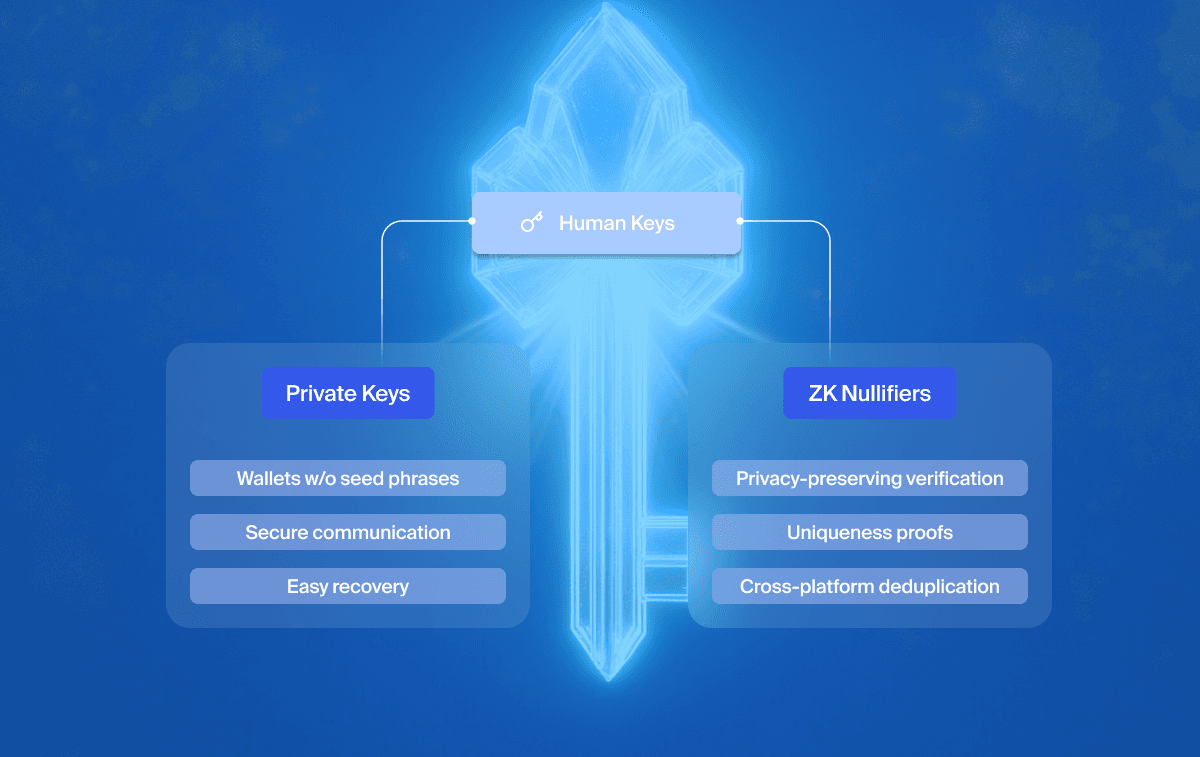
Human Keys are human-bound cryptographic credentials generated through the Human Network. They let users access cryptography using familiar inputs like passwords, security questions, emails, devices, or existing accounts, without exposing raw data or creating centralized honeypots. No seed phrases, no custodians, no fragile device-based secrets.
Human Keys can be re-derived when needed, but remain unlinkable across applications. They eliminate single points of failure and enable recovery without trusted intermediaries. Every Human Key generated is a use of the network that $HUMN secures, and we're already at ~3M.
Fueling Wallet-as-a-Protocol (WaaP) – self-sovereign wallets with safe AI delegation
WaaP is a wallet architecture designed for an AI-native world. It lets you retain cryptographic control while safely delegating constrained capabilities to applications and AI copilots, without ever handing over your private keys. WaaP uses 2PC and threshold cryptography to protect you from blind signing, phishing, and automated exploits. With planned integration of Human Keys and the Human Network, $HUMN's role in securing that network would extend into the wallet layer. WaaP x $HUMN utility may expand in the future.
Backing Human Passport credentials – the privacy-preserving Proof of Personhood
Human Keys are used in the hashing process for Human Passport credentials. Human Network inputs blinded information (computing “Secret-as-a-Service” through vOPRF), and outputs one unique key for every credential requested. This way, we can always determine whether a given user has verified their credential, and they can only do so once (deduplication), while not disclosing any personally identifiable data at all.
One Human Key is created for every credential claimed on Human Passport, fueling the use cases for the $HUMN token. 44 million privacy-preserving credentials have been issued through Human Passport
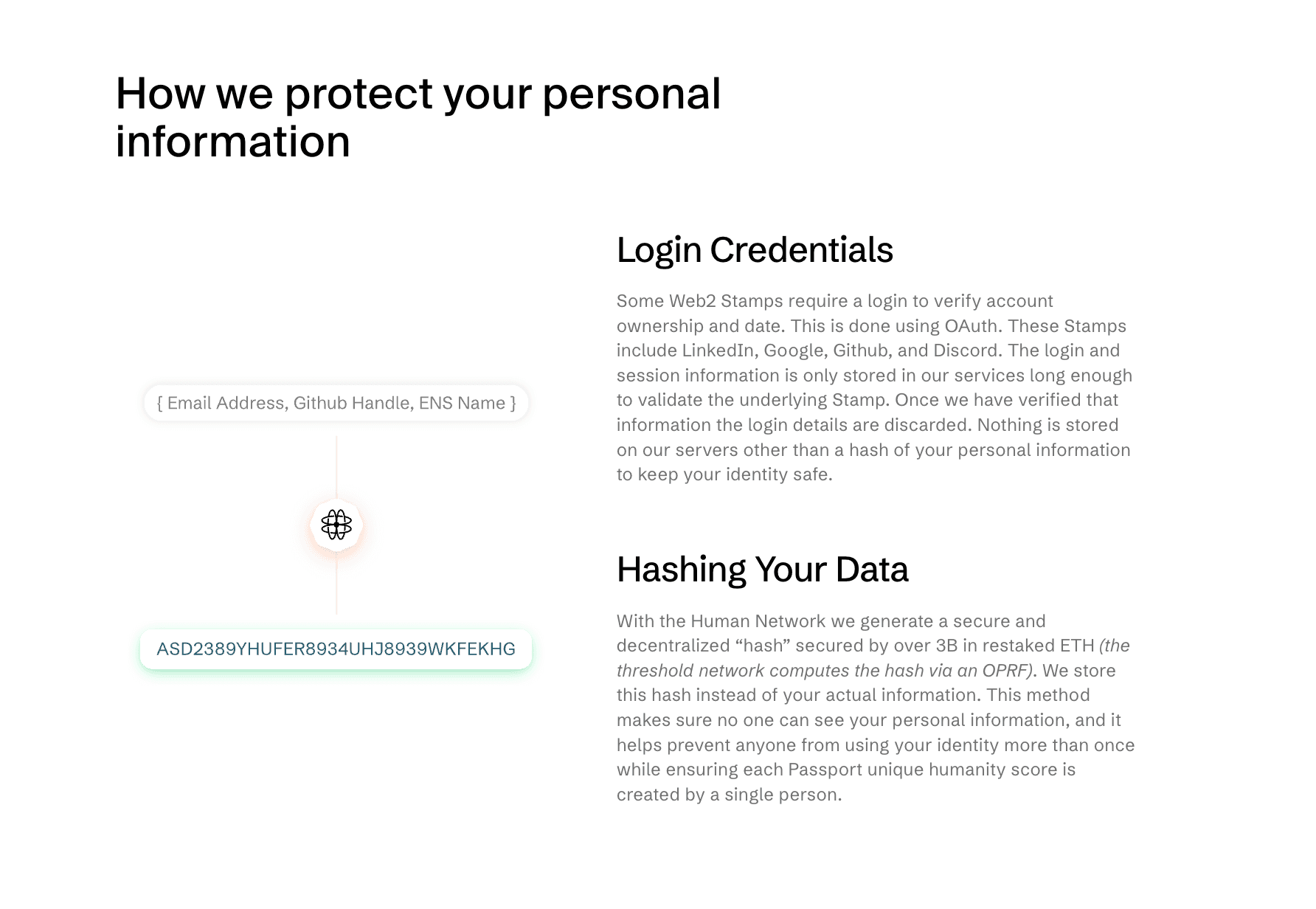
Part of Human Passport’s privacy policy, available at passport.human.tech/privacy.
$HUMN utility #2: Identity Staking via Human Passport – users stake $HUMN to strengthen their Unique Humanity score
Human Passport is a modular proof of personhood system that lets applications verify you're a real, unique human, without centralized accounts or persistent profiles. Over 2.3 million have already used it, and over $500M has been secured from Sybil attacks across over 150 campaigns.
ℹ️ What $HUMN holders can do:
$HUMN will be used for identity staking. You'll be able to stake $HUMN through a Passport-connected wallet to improve your Unique Humanity score, signal commitment, and increase the cost of forgery associated with your identity. Identity staking is entirely optional and designed to recognize genuine humans who want to verify or deepen their commitment.
$HUMN utility #3: Community governance through the DAO – active members can influence the future of $HUMN
From decision-making to ecosystem grants and project support, $HUMN powers the flow from governance to grants to projects, and back again.
ℹ️ What $HUMN holders can do:
Token holders have a chance to influence decisions on ecosystem funding through HUMN Grants. Governance is intentionally staged: starting focused on technical and operational decisions, with authority expanding as participation broadens. The Covenant of Humanistic Technology is the foundation: only verified humans can sign it, contribute, and help shape the future of $HUMN.
Note: holding $HUMN gets you a chance, but it's not the only thing that matters. Governance will weigh verified humanity, contribution, and stewardship alongside token holdings, so control stays with the real community and cannot be bought. Start participating by signing The Covenant at manifest.human.tech.
[*Partnership: Loading***]:** New product release coming soon, with more utility applications for $HUMN
Stay tuned for the announcements.
From Utility to Participation
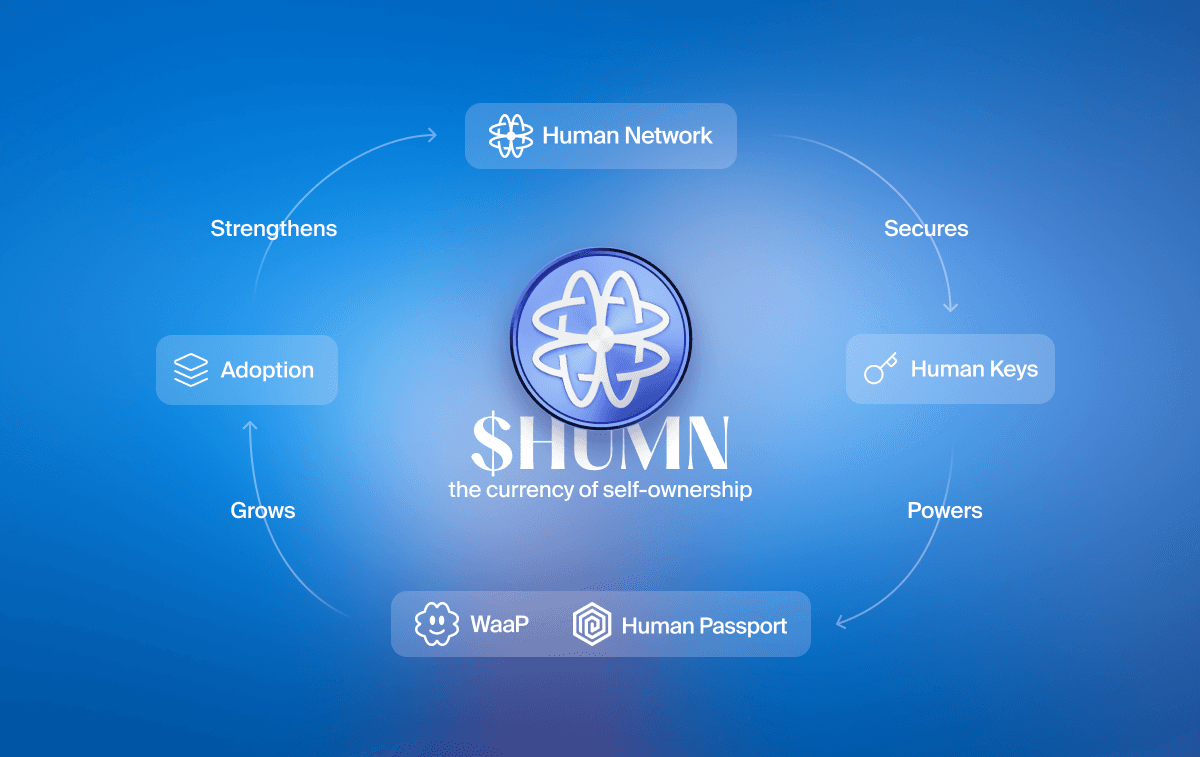
Each layer of the stack reinforces the others, and the Human Network is the shared infrastructure that makes it possible. More operators, more restaking, more ecosystem participation: all means a more secure Human Network. A more secure network means stronger Human Keys. Stronger keys mean stronger credentials through Passport — and, with planned integration, better wallets through WaaP. Better wallets mean more users. More users mean more demand for identity, privacy, and governance. That demand drives more identity staking. ****
How HUMN Points Connect to the Token
HUMN Points are not cosmetic. They're a non-transferable accounting system that measures verified human participation across the ecosystem. Your participation. Points track engagement, contribution, and alignment over time, and may inform future participation criteria within the ecosystem.
HUMN Points campaigns require a valid Human Passport (score > 20) and an active WaaP account. They accumulate across seasonal campaigns:
❀ Season 1: HUMN Onchain SUMR established the baseline by verifying humanity and recognizing early ecosystem participation through Human Passport. Season 1 finished in January 2026.
❀ Season 2: Manifest Your Humanity shifted from verification to contribution, recognizing an active role in shaping the culture, governance, and direction of the ecosystem through The Covenant and its community. Season 2 is still live at manifest.human.tech.
Additional point campaigns recognize WaaP usage, operator contributions, and builder integrations. If you haven’t tried WaaP yet, we suggest you visit waap.xyz and test it yourself. WaaP is now live on Sui network, too!
Participation across seasons reflects engagement with the ecosystem. Season 1, Season 2, and WaaP activity help us understand the community's depth and involvement. Details on how HUMN Points relate to ecosystem participation will be shared separately.
Let’s go, HUMN
The infrastructure is live. The users are real. The cryptography works. Our network is open. What's next is the coordination layer: the mechanism that lets operators, developers, and govern and sustain it together. That’s $HUMN.
The token is coming. It will enable the community to participate directly in the coordination, security, and governance of the ecosystem. You, too, are invited to be HUMN. More details on $HUMN will be shared through official channels.
Stay updated: Follow official channels at human.tech, join the community on Discord, and only trust official links for any future sale or claim process.
HUMN Token FAQ
.png&w=3840&q=75&dpl=dpl_74Do7oHQHPPbYoTK6uSxyAeAknun)
Is the HUMN token live?
It is coming. Follow @humntech on X or Telegram for launch updates. More information will be released as we move closer to token launch. Be mindful of misinformation and scams – there will be others impersonating human.tech team and the $HUMN token. Stay vigilant; scammers these days can be very convincing. Always check information through the official sources. Verify social handles through the human.tech website. In case of questions, reach out to our team on Discord. Stay safe.
What is $HUMN used for?
$HUMN will coordinate the human.tech ecosystem. Core HUMN token utility includes securing the Human Network as the utility fee for the OPRF network, through operator staking, identity staking via Human Passport, community and funding opportunities through the DAO, and facilitating private transactions via [Partnership: Loading…]. It operates at the infrastructure layer and is not required to pay for identity, access, or basic usage.
What are the HUMN token use cases?
$HUMN has three primary use cases: (1) it is the utility fee & securing mechanism of the Human Network, facilitating operator staking and delegation, powering Human Keys generation, (2) identity staking via Human Passport to boost your humanity score and strengthen Sybil resistance, (3) governing the human.tech ecosystem through the community and DAO. Additional utilities may be introduced as the ecosystem evolves.
How can I get $HUMN?
Details will be announced through official channels. Follow human.tech on X and other social accounts for updates. Only trust official links to avoid scams. If you have doubts, ask us on Discord. Verify the authenticity of the Discord link as well. You can always check on our website.
Do HUMN Points matter?
HUMN Points may inform eligibility for future participation in the HUMN ecosystem. Points are accumulated through seasonal campaigns and ongoing activity across Human Passport, WaaP, and The Covenant.
How do I get HUMN Points?
Points campaigns require a valid Human Passport (score > 20) and an active WaaP account. You score points by verifying your humanity, contributing to The Covenant, and using WaaP. While Season 1 (Passport) has already wrapped, Season 2 (The Covenant) is still live at manifest.human.tech.
What is HUMN token identity staking?
Identity staking will let you stake $HUMN with your Passport to signal commitment and increase the cost of forgery. It will increase your Unique Humanity score, but it's entirely optional. Staked $HUMN may contribute to higher reputation scores within Passport, as defined by governance. Identity staking is currently using the $GTC token.
What rights do $HUMN holders have?
Token holders have a chance to influence decisions on ecosystem funding through HUMN Grants and the DAO. Governance is intentionally staged, starting with technical and operational decisions, with authority expanding as participation broadens. Importantly, governance weighs verified humanity, contribution, and stewardship alongside token holdings, so control stays with the real community and cannot be bought. The Covenant of Humanistic Technology is the foundation: only verified humans can sign it, contribute, and help shape the future of $HUMN. Governance does not convey ownership, profit rights, or claims on revenue.
Where can I learn more about $HUMN?
Visit human.tech for documentation, join the community on Discord, and follow @humntech on X or Telegram for announcements.
About human.tech
human.tech is an open framework for aligning technology with humanity through applied cryptography, creating the tools people need to prove they are real, unique, and in control, without sacrificing privacy.
About $HUMN
$HUMN is the coordination token of humanistic technology. It underwrites self-custody, private identity, and financial access for every human, coordinating participation across the human.tech ecosystem to make privacy-preserving personhood possible at a global scale.
Disclaimer: This blog post is for informational purposes only and does not constitute an offer, solicitation, or recommendation to buy, sell, or hold any token or digital asset. $HUMN does not represent equity, ownership, profit rights, or claims on revenue. Nothing in this post should be construed as financial, legal, or investment advice. Participation in the ecosystem involves risks; please consult your own advisors and conduct your own research. Forward-looking statements reflect current expectations and are subject to change.