 General
What Is d/acc: Defensive, Decentralized, Differential Acceleration
What Is d/acc: Defensive, Decentralized, Differential Acceleration
Jan 29, 2026
Technology raises human potential
The printing press broke the monopoly on knowledge and sparked the scientific revolution. The steam engine propelled the industrial revolution, machines outpacing human muscle for the first time. Electricity illuminated cities and minds. Vaccines saved millions of lives. The Green revolution made the planet capable of feeding everyone.
Technology, accelerated and distributed, has been the single greatest force for human flourishing.
Accelerationism without direction can have irreparable consequences
Two trains leave the same station.
One heads toward shared prosperity and human dignity.
The other heads toward inequality, instability, and control by the few.
And the second train often isn't a choice so much as a forced ride, the consequence of irresponsible acceleration that benefits some while leaving others exposed.
As technological accelerationism supercharges humanity's economic and societal potential, unclear direction and centralization quietly replace the mission of building for human autonomy with building for control. The signs are visible through authoritarian tech deployed against citizens, internet shutdowns during protests, social media algorithms that give the illusion of free choice while narrowing what we see and think.
To put this into perspective, Sweden is backing away from its race for a cashless economy, as it creates a single point of failure for nation states to make a cyber attack. This reinforces cash’s stature as a form of financial sovereignty.
AI and quantum computing accelerate this dynamic, as AI decreases the cost of offense and surveillance, while quantum computing can disrupt encryption algorithms that today protect digital payments, health records and private messages . The question isn't whether these technologies will be powerful. It's who will wield that power, and toward what ends.
Do we pause, accelerate, or find a third way?
Pause. Slow down. Regulate first, innovate later. Some advocate for a rationalist remaking of society oriented around risk avoidance. What if we face an Oppenheimer situation, building something we can't control? What if we paused the development of nitrogen fertilizers which enabled mass deaths during wars , now sustains over half of today’s global population. Delay would have cost more lives than it saved. But, is that an argument for developing destructive technology?
Accelerate. Build abundance at all costs, which cure diseases, end poverty, mitigate climate change. Let economic and technological progress compound without friction. But acceleration without direction concentrates power in whoever builds fastest.
Both paths can reshape society and culture in different ways. But they share a common failure: centralization as the governance mechanism, in the hands of whoever moves fastest or regulates hardest.
But there's a third option. One that doesn't require choosing between progress and protection.
The defense advantage
Switzerland's mountains laid the defensive boundary to build resilient, decentralized democratic governance from the bottom up, with local autonomy. This is historical proof for insular, decentralized societies that survive in hostile environments, pointed out by historians like Sara Paine.
The printing press redistributed power back to people that spurred scientific discovery and mass literacy by distributing and reducing the cost of information, making suppression expensive.
Encryption once classified as a legal weapon, today protects every browser session, every bank transfer, every private message. Encryption is a means to liberty.
Apart from having a defensive moat, distributed governance has made these technologies resilient while elevating human autonomy.
Today, our lives are increasingly digital, and so are our liberties. We need defensive technology that is embedded into the infrastructure that we rely on a daily basis.
What is d/acc?
d/acc stands for defensive, decentralized, or differential acceleration. The concept builds on Nick Bostrom's earlier work on differential technological development. The core idea, articulated by Vitalik Buterin: accelerate technology, but prioritize advances that improve defense over harm and distribute power rather than concentrate it.
When defense is cheap and available to everyone, decentralized societies become viable. When defense is expensive and scarce, power consolidates toward whoever can afford it.
Differential means not treating all technologies as equal. Some make individuals harder to coerce. Others make surveillance and control cheaper.
Decentralized and democratic means solving problems without creating new central authorities.
Instead of increasing existential risk, d/acc advocates for deploying more resources and efforts into building technology that makes the lives of people safer and better.
The framework applies across two domains.
- In the world of bits: cryptography, cybersecurity, privacy-preserving systems, and AI alignment.
- In the world of atoms: biosecurity, resilient energy systems, pandemic preparedness, and infrastructure that doesn't depend on single points of failure.
So what should builders actually build? d/acc needs shared commitments that guide how technology gets built – principles that translate into protocol design, governance, and code.
Why this matters now
Digital and physical realms are no longer separate. What happens when your health records or genome data fall into adversarial hands? When the internet shuts down during a protest? When you flee a country and lose every document that proves who you are? When a banking system collapses and you cannot withdraw your own money? When AI moves from a convenience tool to determine your thoughts and actions?
Defensive acceleration asks builders, policymakers, and implementers to build technologies that promote and safeguard human autonomy while resisting centralized control. That means pairing culture and governance with specific technical moves.
What d/acc could look like?
d/acc technology can take many forms. Let's look at social media as an example.
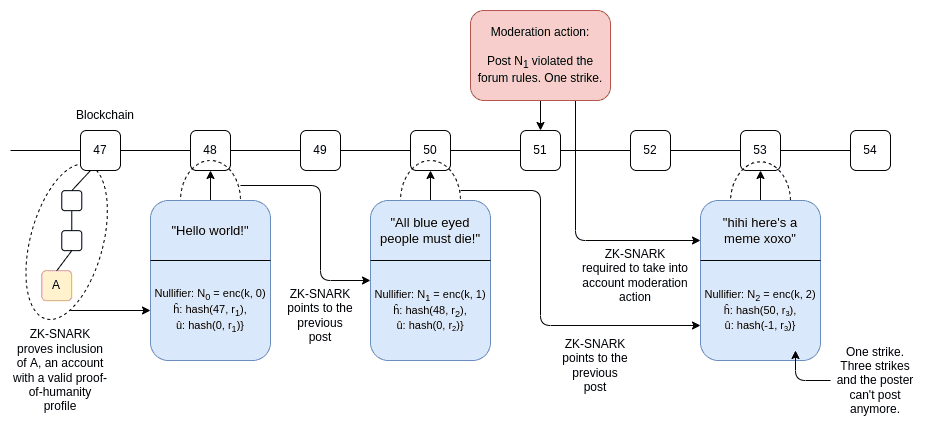
Social media is crucial civic infrastructure today, giving people the agency to speak their minds. But it's controlled by very few players and governments, who shape our thinking with algorithms built for ragebait and polarization.
Imagine if social media were built on a decentralized backend combined with Zero Knowledge (ZK) proofs. This would make the platform more transparent and put users in control.
Here is a proposed design by Vitalik for a ZK social media system, where moderation actions can happen and users can be penalized, all without needing to know anyone's identity.
human.tech Purpose Built for d/acc
human.tech by Holonym Foundation was launched with the urgent mission to embed rights-preserving technology in everyday online interactions, providing open access to peer-to-peer payments, financial inclusion, and self-sovereign digital identity. These pathways are enforced by applied cryptography and secured by decentralized protocols that are governed by the beneficiaries of the technology, not by the organizations that build them.
Holonym’s Covenant of Humanistic Technology provides the guiding principles to ensure that human.tech infrastructure is built to defend and liberate human agency.
The Covenant: From Philosophy to Practice
The Covenant is how we see d/acc becoming more than a philosophy.
The Covenant articulates ten principles we hold self-evident: universal personhood, inalienable ownership, privacy by default, free flow of information and capital, universal security, voluntary accountability, and adaptive resilience. These guiding principles work more like a social contract the technology enters into.
Anyone can sign the Covenant at manifest.human.tech, making their commitment verifiable on-chain. But signing is just the beginning.
We moved these philosophical frameworks into actionable creation through the human.tech Residency at Edge City Patagonia. In November 2025, human.tech and Universal Profiles brought 25 builders, artists, scientists, and activists to the Andes for a 10-day sprint. The goal was to turn Covenant principles into working prototypes. What emerged spanned documentary film, governance frameworks, neurotech systems, open hardware, and AI infrastructure – 11 submissions across five tracks.
The residency proved something simple: when aligned builders share a philosophical anchor, philosophy becomes practice.
Join the Movement
manifest.human.tech is where the Covenant becomes an active community, a place to explore the principles and contribute artifacts of human creation: essays, art, research, and open source systems.
Sign the declaration. Prove your humanity. Submit your artifact. Join the conversation.
The future is being built by humans who care about humans.